

What to Expect in an EMDR Therapy Session (In-Person in Boulder or Virtual in NY/CO)
A typical EMDR session moves through a few distinct beats: we start by checking in and grounding, we spend a few minutes focused on a specific memory or belief while I guide you through bilateral stimulation (usually eye movements, though there are other options), and we close by bringing you back to the present before you walk out the door. You stay aware and in control the entire time. No part of it requires you to narrate your whole story out loud. Here’s what that actually looks like, phase by phase.
What EMDR Actually Treats (and Why I Pair It With Somatic + Parts Work)
EMDR stands for Eye Movement Desensitization and Reprocessing, and I know that’s a mouthful. In plain terms: it’s a treatment that helps your brain finish processing an experience that got stuck. Not “stuck” in a vague, poetic sense — “Stuck” in this case meaning that a memory can still spike your heart rate years later, even though you know, logically, that you’re safe now. The working theory behind why this happens is that bilateral stimulation helps your brain access its own natural information-processing system, the same one that lets most everyday experiences get filed away without leaving a charge behind.
I’m an LMHC trained in EMDR alongside somatic and IFS-informed work, which shapes how I use it: not as a stand-alone technique, but as one part of a body-attuned approach to trauma.
That gap between knowing and feeling is exactly why I don’t use EMDR on its own. In my trauma therapy work, I pair it with somatic awareness and IFS-informed parts work, because reprocessing a memory and reconnecting with your body’s felt sense of safety are two different jobs, and most of my clients need both.
“I’ve Already Done the Work” — Why EMDR Might Still Help
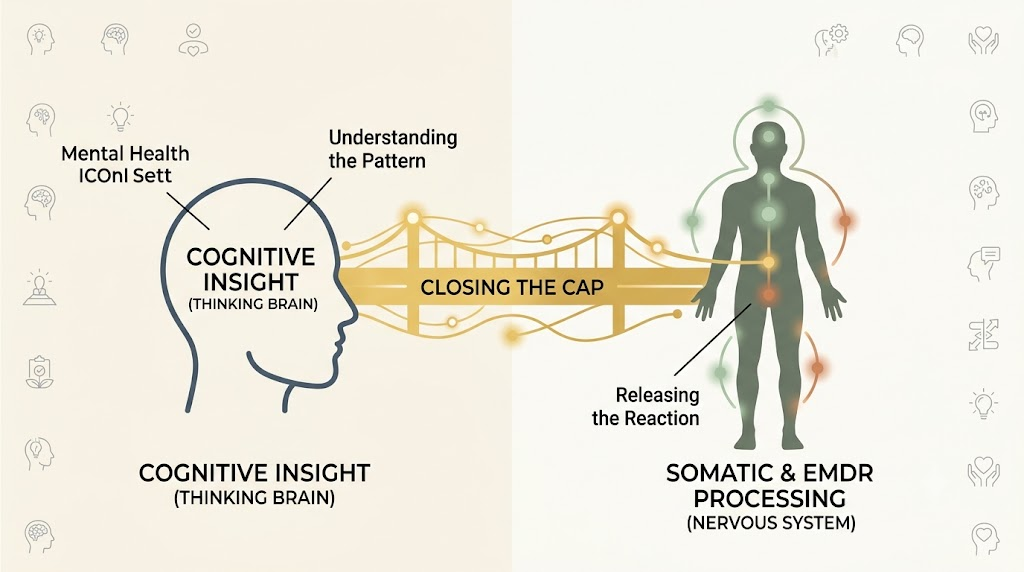
Most of the people who end up in my Boulder office or on a video call with me aren’t new to therapy. You’ve probably read the books. You can name your attachment style, trace your patterns back to where they started, and explain, clearly and insightfully, exactly why you react the way you do. And you’re still reacting the way you do. This shows up across most of what I treat — anxiety, codependency, life transitions, trauma — not just in trauma work specifically.
That’s not a problem. It’s how the nervous system works. Understanding a pattern happens in the thinking part of your brain. Changing how your body responds when the pattern gets triggered is a different kind of work entirely, and talk therapy, as valuable as it is, doesn’t always reach it. EMDR is one of the more direct ways I know to close that gap. It not only gives you more insight, but it also helps your nervous system finish processing the experience the insight is actually about.
If this is where you’re at, intellectually fluent in your own story but still getting hijacked by it in real moments, this is usually exactly who I have in mind when I offer EMDR as part of someone’s care.
Before Your First EMDR Session
I don’t start reprocessing on day one, and I’d be cautious of any therapist who does. The first several sessions are about history-taking and stabilization: I’ll ask about what’s bringing you in, what patterns you want to shift, and what’s happened in your life that might be contributing. You don’t need to remember every detail of your past for this to be effective. I’m listening for patterns, unprocessed emotions, and what your experiences have meant to you.
Alongside that, we build a toolkit of resource and regulation skills: grounding techniques, breathwork, as a way to signal “I need to pause” that doesn’t require you to explain yourself mid-session. This is what makes the reprocessing work actually feel safe instead of overwhelming once we get there. Some clients move through this stage in a session or two. Others need longer, and that’s genuinely fine. We go at the pace your system can tolerate, not the pace a treatment manual says we should.
What Happens During a Reprocessing Session
This is the part people are usually most curious (and nervous) about, so let me walk you through it plainly.
Once we’ve identified a memory or belief to work on, I’ll ask you to briefly bring it to mind — the image, the emotion attached to it, where you notice it in your body. Then we begin bilateral stimulation, most often by having you follow my fingers or a light bar with your eyes, side to side. If eye movements aren’t comfortable for you, we can use alternating taps or tones instead — the mechanism is the same either way.
You’re not narrating the memory out loud while this happens. You’re just noticing what comes up: images, sensations, other memories, sometimes nothing dramatic at all. After a set of movements, I’ll check in briefly, asking what you’re noticing now, and we continue. Over the course of the session, most people notice the emotional charge of the memory shifting. It doesn’t disappear or get erased. It tends to feel more like something that happened, rather than something that’s still happening to you right now.
You are in control the entire time. If something feels like too much, we slow down or stop — that’s not a failure of the process, it’s the process working correctly. My job in the room is to track your nervous system as closely as I’m tracking the clock, and I work to close every session with you feeling grounded rather than activated before you leave.
It’s worth knowing ahead of time that reprocessing can bring up physical sensations, not just emotional ones. Some clients notice tingling, a wave of warmth, tension releasing from the shoulders or jaw, or even a small tremor moving through the body. This can feel strange the first time it happens, but it’s a normal part of how the nervous system discharges stored activation — it’s not a sign that anything is going wrong, and I have a whole toolbox of somatic techniques to support you during the session itself.
In-Person in Boulder vs. Virtual in NY/CO: What’s Different
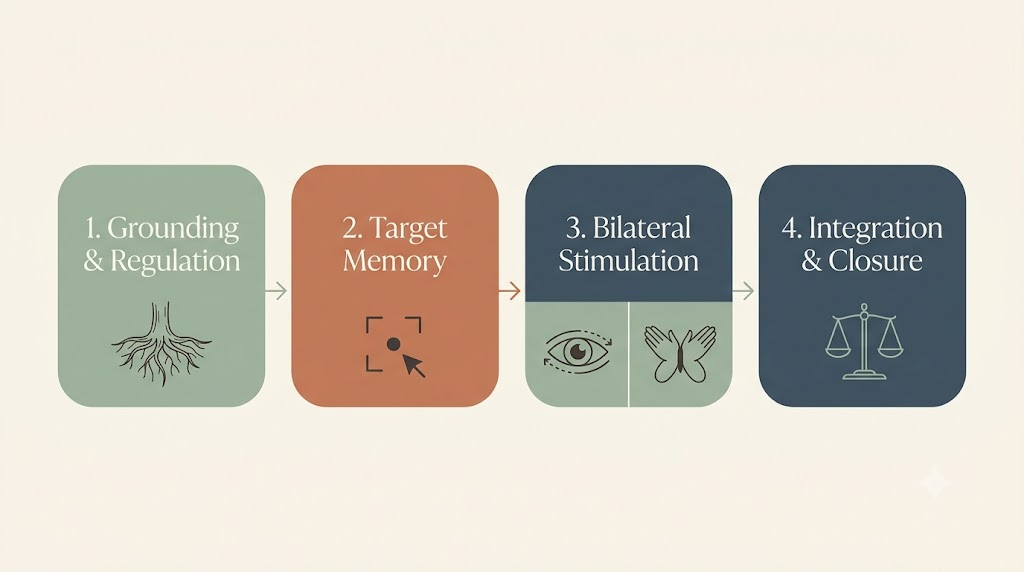
I offer EMDR both in-person at my Boulder office and virtually to clients throughout New York and Colorado, and the honest answer is: there isn’t much of a difference?
The structure stays identical — history, stabilization, reprocessing, closure — and you’re just as much in control over a screen as you are in my office. What changes is the mechanics of bilateral stimulation. In person, I’ll often use hand buzzers, a light bar, or tapping. Virtually, we typically shift to self guided eye movement or self-tapping or a self-tapping technique I’ll teach you (crossing your arms and tapping your own shoulders, left-right-left), both of which work through the same mechanism.
If you’re weighing the two: in-person in Boulder can feel more contained for some people, especially early on, simply because you’re in a dedicated space with fewer distractions. Virtual EMDR tends to work well once you have a private, comfortable spot at home, and for a lot of my clients in Denver, Fort Collins, or across New York, it’s simply the more realistic option given schedules and distance. Neither is a downgrade. I’ve had plenty of clients do deep reprocessing work over telehealth with real, lasting shifts.
After Your Session: Integration and Aftercare
It’s normal to feel tired after an EMDR session, sometimes more tired than you’d expect from EMDR sessions. typically 60-120 min of your brain was working hard. Some clients notice vivid dreams, unexpected memories surfacing, or a wave of emotion a day or two later — this is usually just your nervous system continuing to do its work.
I’ll always leave time at the end of a session to help you close out and re-orient before you head back into your day, and I’ll check in with you at the start of our next session about anything that came up in between.
A few things that help in the day or two after a session: give yourself a buffer rather than scheduling something high-stakes right after, drink some water, eat some nourishing food, and don’t be surprised if you feel unusually tired that evening. Plenty of clients tell me they slept hard the night of a reprocessing session. If you notice a memory or feeling resurfacing between sessions, jotting it down (even just a phrase) gives us something concrete to pick up next time, though this is optional, not homework.
None of this is linear. Some sessions feel light and uneventful. Others bring more up than you expected. Both are normal, and part of what we’re doing in the stabilization phase early on is making sure you have the tools to handle either. If you want to read more about how the body holds and processes experience outside of a session, I’ve written about it more on my blog.
Session Fees and Logistics
I’m an out-of-network provider, which means I don’t bill insurance directly. Individual sessions are 50 minutes at $200, and payment is processed automatically at the time of service. If you’d like to seek out-of-network reimbursement, I’m happy to provide a superbill for you to submit to your insurer — I’d just recommend calling them first to understand what your specific plan covers. You can find more detail on how sessions and payment work on my FAQ page.
Frequently Asked Questions About EMDR
Does EMDR hurt, or can it re-traumatize me? No. You’re never asked to relive an experience in detail, and you’re in control of the pace throughout. If something feels like too much, we pause. Going at your pace is an essential part of the treatment.
I’ve already done years of talk therapy — will EMDR actually help? Often, yes, and this is one of the most common reasons clients come to me for it specifically. Talk therapy is excellent for understanding your patterns. EMDR works differently: it helps your brain finish processing the experience underneath the pattern, which is often what closes the gap between “I understand this” and “I don’t react this way anymore.”
How many sessions will I need? It varies. Some clients notice meaningful shifts within a handful of sessions once we reach the reprocessing phase; others, especially with more complex or layered histories, benefit from longer-term work. We’ll build a plan together and adjust it as we go.
Is EMDR available over telehealth? Yes — I offer EMDR virtually to clients throughout New York and Colorado, using adapted bilateral stimulation techniques, alongside in-person sessions in my Boulder office. (More on how EMDR fits into therapy with me on my FAQ page.)
Is EMDR evidence-based? Yes. EMDR is a recognized treatment for PTSD supported by decades of clinical research, and it’s also used for anxiety, panic, and other forms of emotional distress that trace back to unresolved experiences. Different clinical guidelines weigh it a bit differently — for instance, the American Psychological Association’s most recent guideline lists EMDR alongside other well-supported options rather than as the single default — which is part of why I don’t treat it as a stand-alone fix, but as one tool I bring in when it fits what a client actually needs.
Ready to Talk It Through?
If any of this resonates, if you’ve done the work of understanding yourself and you’re still waiting for that understanding to actually change how you feel, EMDR might be the missing piece. It’s one of the tools I use most often in trauma therapy, alongside somatic work and IFS-informed parts work, because insight alone rarely gets you all the way there.
I offer a complimentary 15-minute discovery call if you’d like to ask questions and see whether this feels like the right fit. Schedule a discovery call here. I’d love to hear from you.