

You found a therapist who feels like the right fit: the modalities make sense, the approach feels human. Then you get to the fee page. No insurance accepted. Suddenly you’re doing mental math about whether this is even possible for you.
That reaction is completely fair. Insurance is supposed to make care more accessible, so finding out your provider isn’t in-network can feel like a wall going up right when you were ready to walk through a door.
Here’s what I want you to know before you close this tab: staying out-of-network wasn’t a shortcut I took. It’s a decision I made on purpose, for reasons that directly shape the kind of care you’d get from me. And it applies the same way whether you’re sitting across from me in my Boulder office or meeting me by video from New York or anywhere in Colorado.
Quick answer, if you’re short on time:
- I’m out-of-network by choice, not because I couldn’t get credentialed with an insurance panel
- Sessions are $200 for 50 minutes, and I can provide a superbill so you can seek partial reimbursement
- Everything below applies whether you’re in-person in Boulder or working with me via telehealth in New York or Colorado
Do I Accept Insurance?
No. I’m an out-of-network provider, which means I don’t bill your insurance company directly, and you pay my full session fee at the time of service.
That said, I can provide you with a superbill on request. It’s a document you can submit to your insurance company for possible out-of-network reimbursement. I’ll walk through exactly what that looks like further down. Before you book, I’d genuinely recommend calling your insurer directly to ask about your specific out-of-network mental health benefits, since every plan handles this differently.
Already sure this is the right fit? Book a discovery call now, or keep reading for the full breakdown of costs, superbills, and reimbursement.
Why I Choose to Stay Out-of-Network
So let me actually explain the reasoning instead of just stating the policy.
Insurance companies don’t just pay claims — they set the terms of your care. They can cap how many sessions you’re allowed, dictate how often you meet with me, limit session length to 45 minutes, and require a formal diagnosis before they’ll cover anything at all. None of that is about what actually helps you. It’s about what a payer is willing to fund.
You’re also not the only one running into this. Federal law technically requires most insurance plans to treat mental health coverage on par with physical health coverage. But in practice, more than 1 in 4 people who receive psychotherapy end up seeing an out-of-network provider. That compares to just 7% for medical specialists.
The Real Cost of “Free” Insurance Coverage
Working within insurance panels means seeing a much higher volume of clients, because reimbursement rates are typically a fraction of a therapist’s standard fee. This forces therapists to make a difficult choice: either take on a caseload that limits how much real attention any one person gets, or step outside that system entirely.
I chose the second option so I can stay small and intentional. That means more time for research, my ongoing EMDR and trauma-focused training, and the detailed session notes I use to track your progress: not administrative hours spent on insurance paperwork instead of on you.
This isn’t just my own reasoning, either. One national study found that when people deliberately choose an out-of-network mental health provider, the top reasons are the provider’s perceived skill and continuity of care, not a lack of in-network options.
Why This Matters for Trauma and Somatic Work Specifically
Trauma and nervous system work doesn’t move on a fixed schedule. Some weeks call for more support. Others call for space to integrate what already happened in session, without rushing toward the next scheduled slot.
Insurance-driven session caps and rigid diagnostic requirements work directly against that kind of pacing. Being out-of-network means I set the pace based on what your system can actually tolerate, not what a treatment plan says we should have finished by now.
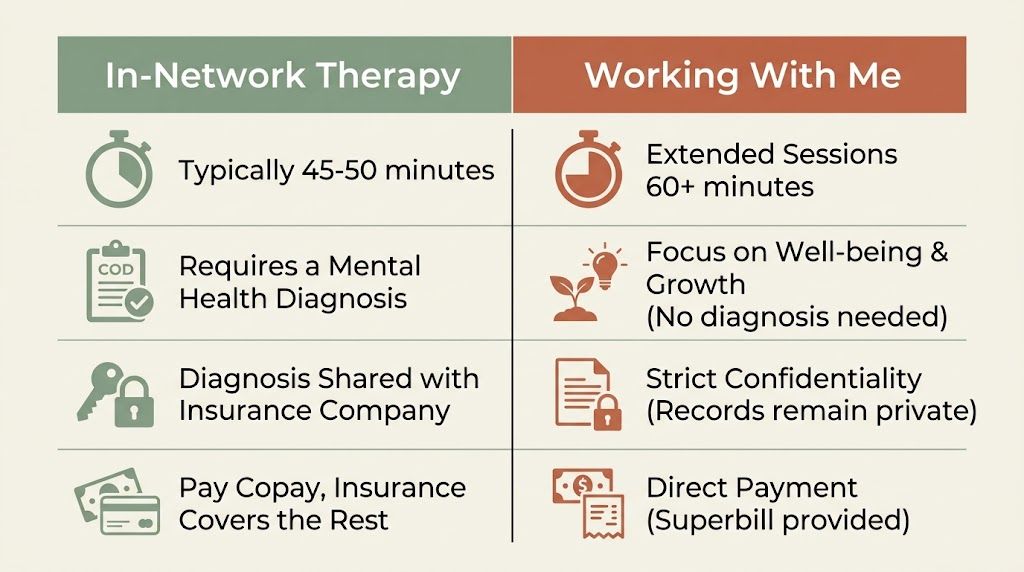
| In-Network Therapy | Working With Me | |
| Session length & frequency | Set by your insurance plan | Set by what you actually need |
| Diagnosis required | Usually, to justify coverage | Not required to begin working together |
| Who sees your records | Your insurer has access to diagnosis and treatment notes | Stays between us, protected by HIPAA |
| Cost structure | Copay, set by your plan | Flat rate, paid directly to me |
My full therapy FAQ covers the full list of how I practice: cancellation policy, session length, what a first session looks like.
What This Actually Costs
Individual sessions are 50 minutes, and my current rate is $200 per session. Payment is auto-drafted at the time of service using a credit card, HSA, or FSA, so there’s no invoice to chase down afterward.
If you need to cancel or reschedule, just give me 48 hours’ notice to avoid a cancellation fee. Life happens, and I’d rather you tell me than stress about it.
What Is a Superbill, and How Does It Work?
A superbill is an itemized receipt for therapy you’ve already paid for out of pocket. Instead of your insurance company paying me directly, they may reimburse a portion of what you already paid me, if your plan includes out-of-network benefits.
In plain terms: you pay me, I give you a detailed document, and you submit that document to your insurance company yourself. Whatever comes back is your money to keep, not mine. I’m not involved in the claims process beyond providing the paperwork.
What’s on a Superbill
- Your name and basic identifying information
- My credentials (LMHC in New York, LPC in Colorado), license number, and National Provider Identifier (NPI)
- The date of each session and the service provided
- A diagnosis code and a procedure code, which your insurer requires to process the claim
- The amount you paid, itemized by session
How to Submit It
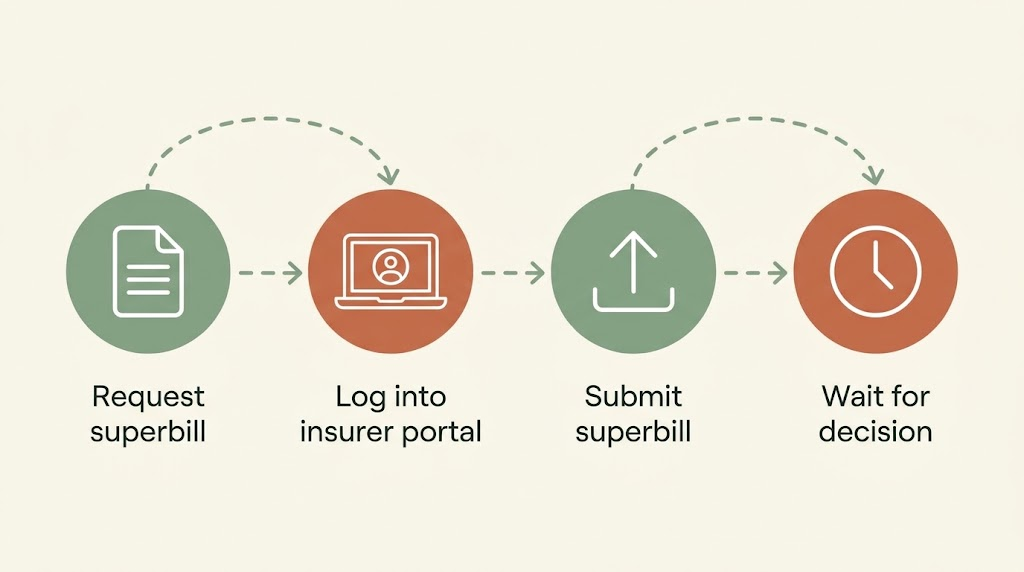
- I automatically provide you with a superbill at the end of every montht
- Log into your insurance company’s member portal and look for a claims or reimbursement section
- Upload the superbill, or mail or fax it if your insurer requires that instead
- Wait for your insurer’s decision, which can take anywhere from a few weeks to a couple of months depending on your plan
How Much Could I Get Reimbursed?
Reimbursement isn’t guaranteed, and it depends entirely on your specific plan. But here’s roughly how the math tends to work:
- You pay me $200 for the session.
- Your insurer sets an “allowable amount” for that type of session (say, $160). That’s the most they’ll consider, no matter what you actually paid.
- If your plan covers 70% of that allowable amount and you’ve already met your out-of-network deductible for the year, you’d likely be reimbursed around $112.
That’s not the full $200 back. But it’s also not nothing, and it’s worth knowing before you rule out out-of-network care as unaffordable. Every plan calculates this a little differently, which is exactly why the questions in the next section matter.
What to Ask Your Insurance Company Before You Book
Before your first session, call the number on the back of your insurance card and ask specifically about mental health out-of-network benefits. Generic questions get generic answers, so here’s what to actually say:
- “Do I have out-of-network benefits for outpatient mental health therapy?”
- “What’s my out-of-network deductible, and have I met it this year?”
- “What percentage of the allowable amount do you reimburse after the deductible?”
- “Do you require prior authorization for out-of-network mental health services?”
- “How do I submit a superbill, and how long does reimbursement typically take?”
Write down the answers, along with the date you called and who you spoke with. Insurance representatives can give inconsistent information from one call to the next, and having a record protects you if there’s a dispute later.
My complete FAQ on session policies has the full breakdown of everything else about how sessions work: what to expect, how long therapy usually takes, whether I offer couples sessions.
Does This Work the Same for Telehealth in New York?
Yes. Everything above applies whether you’re seeing me in person in Boulder or meeting virtually from New York or anywhere in Colorado. I’m licensed in both states, and out-of-network benefits work the same way for telehealth sessions as they do for in-person ones.
The one thing worth double-checking is whether your specific plan treats telehealth mental health visits any differently for reimbursement purposes, since some do. That’s one more good question to ask when you call.
Is It Worth It?
Only you can answer that, and it’s a fair thing to sit with. Paying out of pocket is a real cost, and I don’t want to minimize that.
What I can tell you is what you’re paying for: therapy that isn’t shaped by what an insurance company will approve, from someone who has the time to actually stay present with you instead of rushing toward the next intake. If you’re tired of therapy that felt capped, rushed, or disconnected from what you actually needed, this might be the difference that matters.
Clients who’ve made this choice often describe the shift directly. One shared that our work together “equipped me with the tools to cope with anxiety that I still use today.”
If you’re still weighing it, a discovery call costs nothing and commits you to nothing.
Bottom line: I don’t take insurance so I can offer individualized, unrushed care without a payer setting the terms. Sessions are $200 for 50 minutes, and I can provide a superbill so you can seek partial reimbursement if your plan offers out-of-network benefits. This applies whether you’re in-person in Boulder or telehealth in New York or Colorado.
Curious what a session actually looks like once you’re in the room? Read What to Expect in an EMDR Therapy Session.
Ready to Talk It Through?
I offer a complimentary 15-minute discovery call: a low-pressure, zero-obligation conversation where you can ask questions, share what you’re looking for, and see if this feels like the right fit before you commit to anything.
About the author: Rebecca Kelso, LMHC, is a licensed therapist in New York and Colorado specializing in trauma-informed somatic therapy, EMDR, and IFS. She brings over a decade of mind-body experience from her background as a yoga and movement therapist to her clinical work today. Learn more about Rebecca.
This article is for general informational purposes only and isn’t a guarantee of insurance reimbursement. Contact your insurance provider directly to confirm your specific out-of-network mental health benefits. If you’re experiencing a mental health crisis, call or text 988 (Suicide & Crisis Lifeline) or contact your local emergency services.